SREcon26 EMEA: Architecture, Doom and the Agents on Call

Everyone at SREcon was talking about AI, but the talks that stuck with me were really about understanding: how we design systems, how we see them, and who gets listened to when they break.
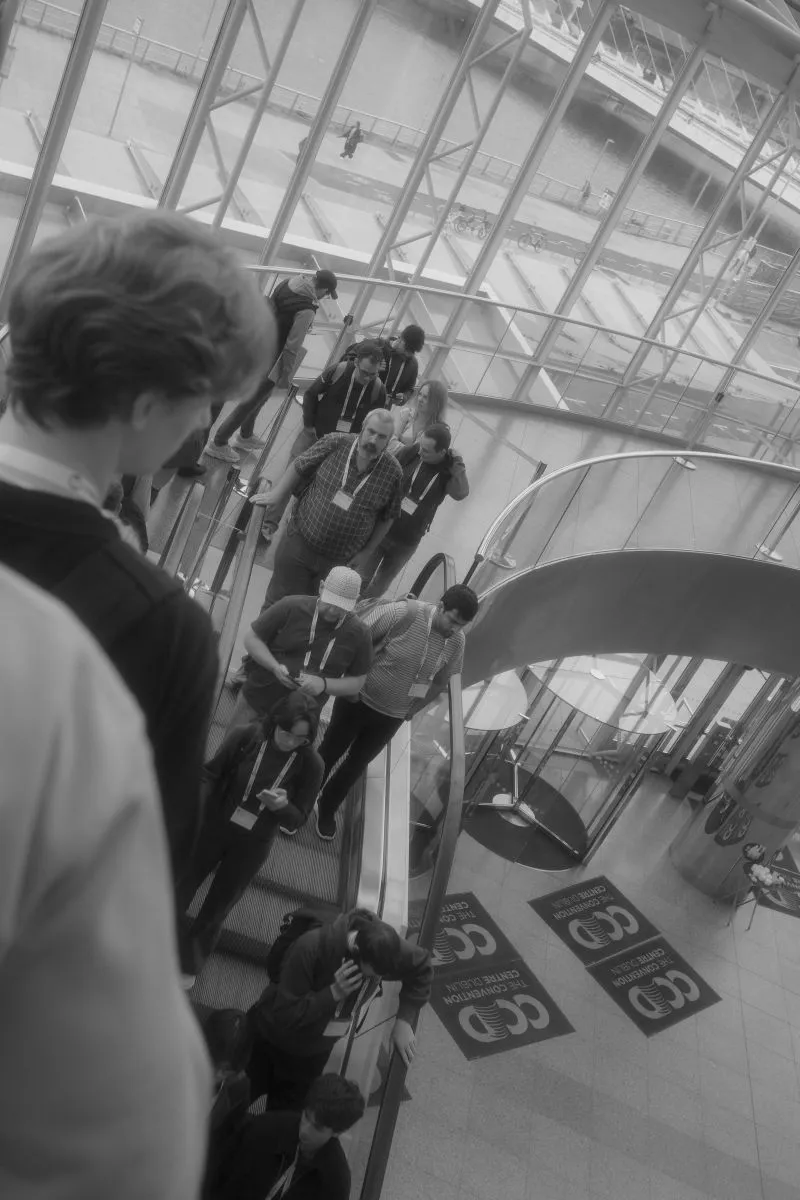
This year I went to SREcon for the first time: SREcon26 EMEA, held at the Convention Centre Dublin from 13 to 15 October.
One of the first things I noticed was that an AI conference was running in the same building at the same time. That felt about right, because AI was everywhere at SREcon too: in the talks, in the hallway conversations, and referenced in plenty of sessions that weren’t officially about it.
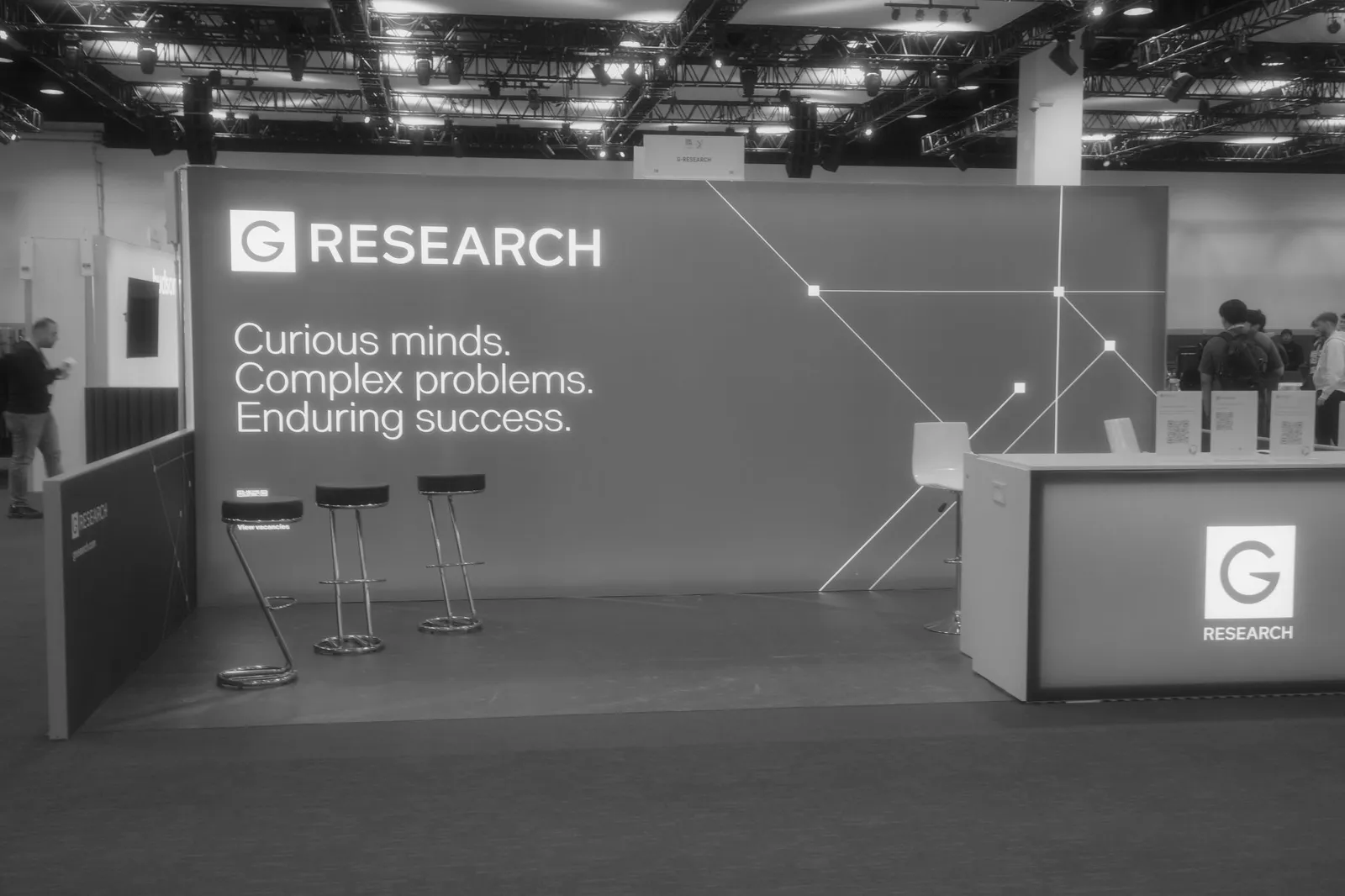
The vendor hall had who you’d expect, from Datadog to Grafana, as well as newcomers like Bronto and plenty of companies like G-Research, where I work now. What stood out was the observability data companies. OpenObserve and ClickHouse were there as gold sponsors. Meanwhile the big names weren’t necessarily the big booths. Datadog, for example, didn’t have a massive stand, which I found interesting.
Here are the talks I found most interesting, in the order I saw them: the ones that got me thinking outside the box.
Le Corbusier vs Frank Lloyd Wright
Dave O’Connor · Astronomer
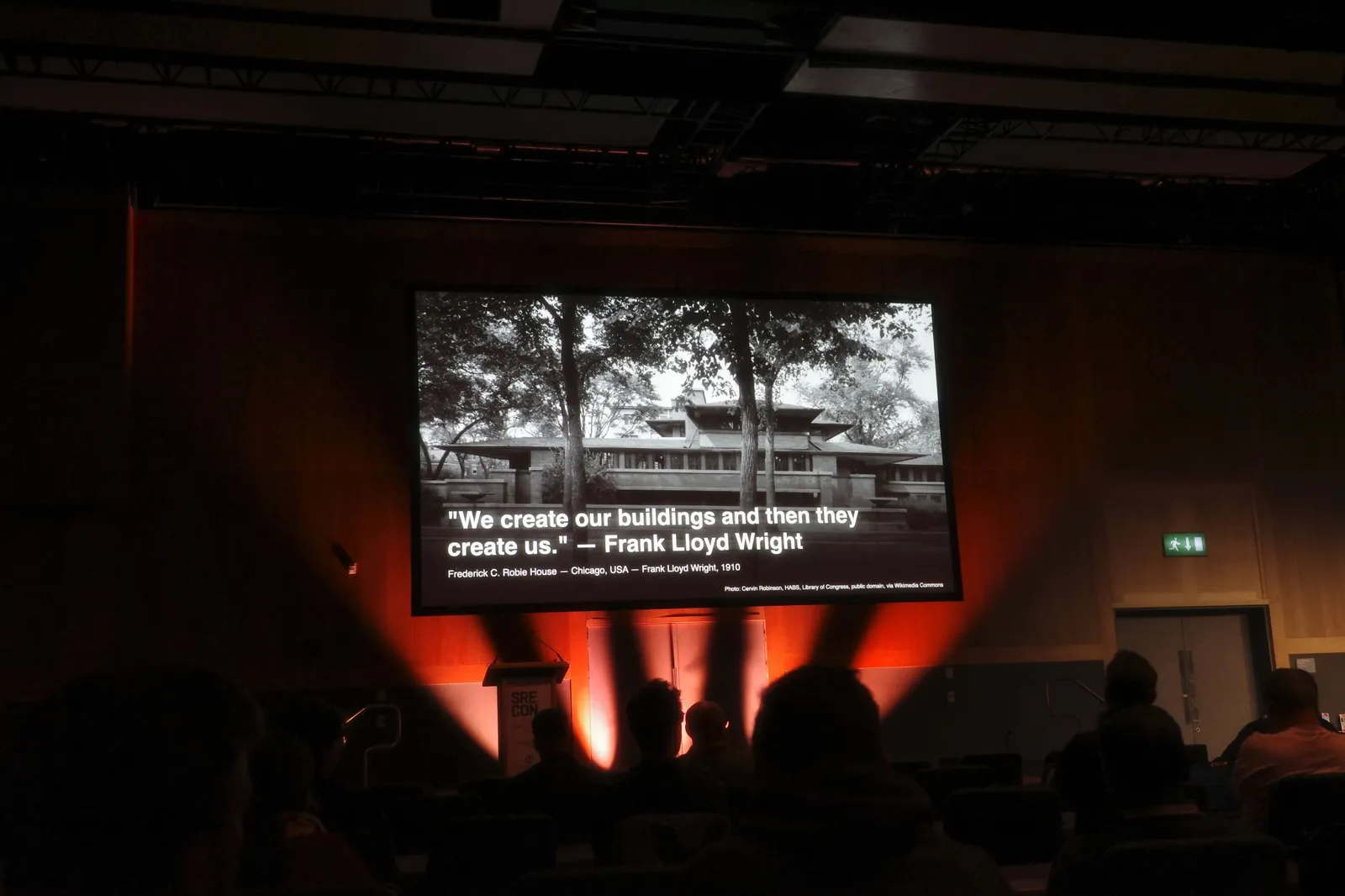
Dave O’Connor (Astronomer, formerly SRE Director for Storage and Databases at Google) opened the conference with Perspectives from the Architecture of the Built Environment. His argument is that production systems shape the people who operate them, the same way buildings and cities shape the people who live in them.
The part that stuck with me was about designing infrastructure properly versus building things simply because you can. He used the 20th century’s big architects to make the point. Le Corbusier worked in repeatable patterns: modular, uniform and principled, so the design makes sense wherever you stand in it. Frank Lloyd Wright pushed the limits of what was possible, often choosing the less uniform option to wow the people inside.
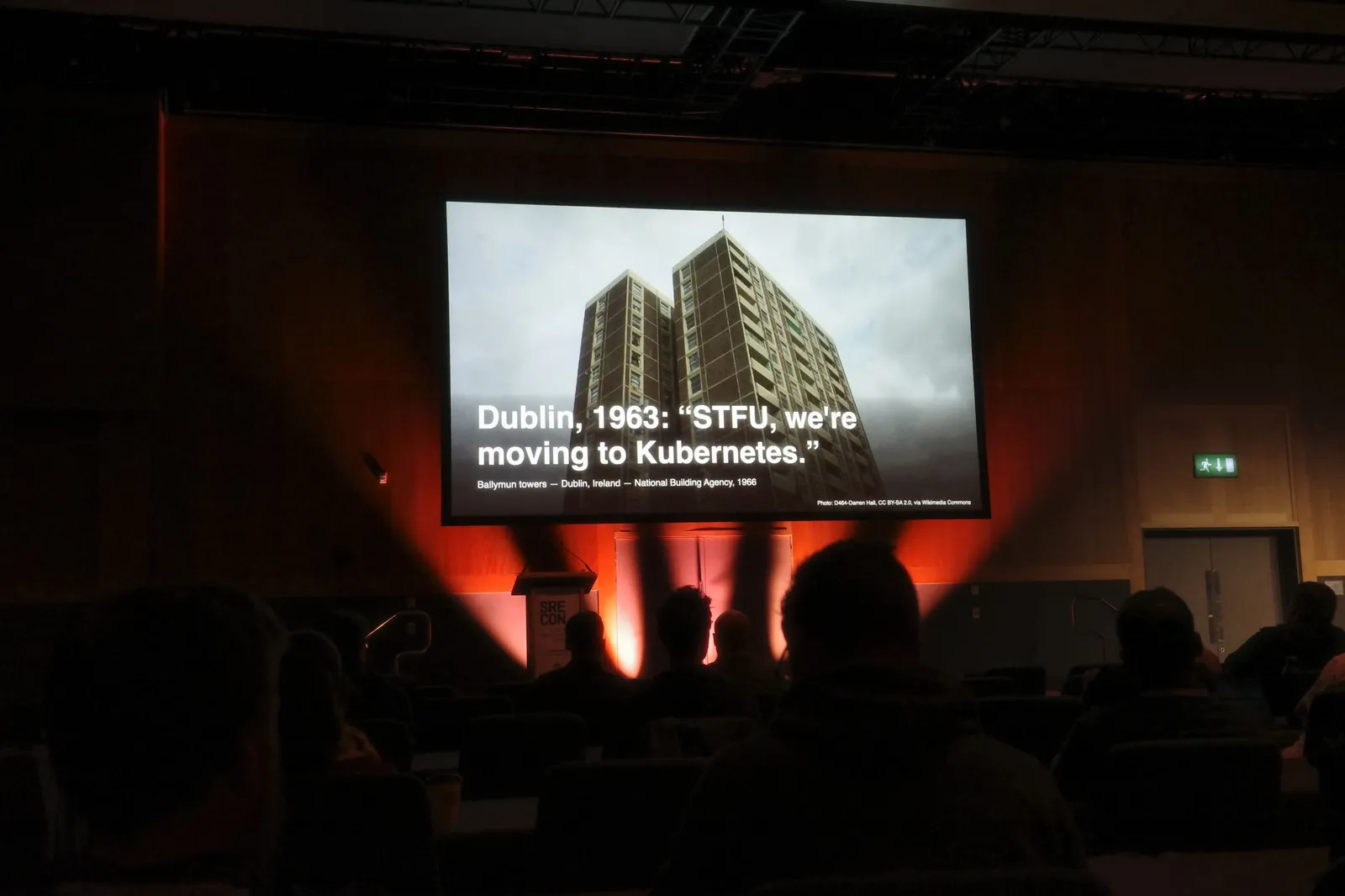
Both work. They just give you very different buildings to live in. I’d go further and say it’s the modern Microsoft versus Apple split: one built on consistent, repeatable patterns that scale, the other built around the experience and willing to break convention to get it.
For infrastructure, it’s a useful question to ask before you build: are you laying down a pattern people can learn once and use everywhere, or a one-off they’ll have to rediscover every time something breaks?
Performance prompts
Brendan Gregg · OpenAI
I’ll admit up front that I’m a huge Brendan Gregg fan, so this was one of the talks I’d circled before I even arrived.
He needs no introduction if you’ve ever looked at a flame graph. The Australian performance engineer created them, wrote Systems Performance and BPF Performance Tools, and now works at OpenAI on performance and cost for ChatGPT. His plenary, Performance Prompts, described three eras of performance engineering: performance maths, then performance tools, and now performance prompts, where AI agents analyse flame graphs, eBPF output and CPU counters for you.
What I took from it was a man with decades of experience and dozens of tools behind him, somewhat on the back foot. Across the industry, engineers without anything like his depth of expertise, who don’t fully understand what’s going on underneath, are now making real performance improvements with AI.
So what happens when one of the leading minds in a field is overtaken by a junior engineer with a Claude subscription?
What I loved is that he seemed to be asking that question himself. He didn’t wave it away, and you could feel some real sentiment about it in the room. Seeing someone I’ve learnt so much from be that candid about his own field changing under him was genuinely amazing.
Understanding matters. But how much it matters is a fair question. If the results mean you’re getting far more out of your GPUs, or improving your monitoring and making decisions with confidence, does it really matter whether you have decades of experience behind you?
I think what does matter is being able to tell the story of the data and show it clearly. That’s going to become very important.
Running around a VM in Doom
Adam Leskis · Kraken Tech
Adam Leskis (Kraken Tech, and a teacher before he moved into tech) gave Automating AI out of a Job: Vibing SRE Learning Materials. The idea is to use AI to build tools that help people actually learn, instead of just asking the AI every time.
Computing is hard. Once we’re inside it, we forget that.
His demo connected a virtual machine to Doom through a shim, so you could literally run around the machine and see its resource constraints. A memory fault became something you could find. IOPS spiking at a certain moment became something you could see happening. You could keep going deeper and deeper.
It brought the system to life in a way a dashboard rarely does. To be clear, this isn’t an incident tool. Nobody is going to jump around a map mid-outage to work out what’s wrong. It’s about education and training. I think it has a real place in teaching complex systems to kids, university students and new engineers, and it’s a great example of using AI to build views that make complex systems easier to understand, not just quicker to query.
Forty years after Challenger
Robert Barron · IBM
Then came Robert Barron (SRE and AIOps lead at IBM, and an aerospace history enthusiast) and From Space to Software: Reliability Lessons 40 Years after Challenger.
Spacecraft blowing up is obviously not great. But the point of the talk was that Challenger wasn’t really a technical failure. The engineers knew about the O-ring risk before the launch. What failed was everything around them: the decisions, the incentives and the escalation paths.
That really hit home. You need the ability to speak up to power, to put your hand up and say “I think this is a problem and I’m not sure we should go ahead.” The engineers did exactly that. They raised the alarm, and argued against launching in the cold the night before. Unfortunately, the pressure to launch won, and their concerns didn’t make it through the escalation chain with the weight they deserved. The data was there, but it wasn’t presented in a way that could overcome everything pushing towards a launch. The aftermath, through the Rogers Commission, drove real changes in how NASA handled safety concerns and who got to say no.
Same theme again: the data is only as good as the story you can tell with it.
AGI and SRE
Alex Palcuie · Anthropic
The most unsettling talk was one of the last. Alex Palcuie, who works on Claude’s inference reliability at Anthropic after eight years as an SRE on Google Compute Engine, gave the closing plenary: AGI and SRE.
Anthropic run fleets of SRE-equivalent agents that monitor their infrastructure. The agents act as watchdogs: they page people, and they also try to fix things themselves. It’s a genuinely novel way to operate. Whenever I use Claude now, I remember that a big part of what keeps it running is effectively self-governing, and almost self-healing.
The way I understood it, this has reduced incidents, but it has also cut down on knowledge sharing between the humans. That’s the trade-off that stuck with me. There was also a strong sense of “this is what we asked for” running through the talk. Anthropic are obviously pushing hard on what’s possible here, and it’s really cool to see. But the argument that a model could match an SRE at paging, mitigating incidents and reasoning about production within the careers of the people in the room is a lot to take in before the closing drinks.
What I’m taking away
Everyone is talking about AI usage
Every talk, every hallway conversation, every vendor booth. More than once I was asked whether we have unlimited tokens at G-Research. The question is no longer whether teams use AI, it’s how much and on whose budget.
How we present data is shifting
You could see this clearly in the vendor hall. Two years ago you picked a vendor and it did everything: collection, storage, querying, dashboards. Now the data backend is becoming the observability platform in its own right, which is why companies like ClickHouse and OpenObserve are on such a big stage.
The question people are asking has changed too. It’s not “which dashboard tool?” anymore. It’s “how do we let agents interact with our backends?” If agents are going to hold the pager, they need the raw data, not a pretty picture of it. And the humans still need a way to see the story, whether that’s a flame graph, a well-made chart or a VM you can run around in Doom.
Don’t let AI write your slides for you
A takeaway for anyone giving talks: don’t get AI to build your slides and then never review them. There was a fair amount of slop on screen this year. You could tell when Claude had clearly built someone a web app of slides. They looked great and were packed with information, but the speaker wasn’t actually talking about most of what was on them.
Polished isn’t the same as engaging. The slides should support what you’re saying, not compete with it. If you want genuine feedback and a genuine conversation from the room, give them something you actually made and actually stand behind.